Convert your GPBoost model into a standardized representation.
The returned representation is easy to be interpreted by the user and ready to be used as an argument in treeshap() function.
gpboost.unify(gpb_model, data, recalculate = FALSE)Arguments
- gpb_model
A gpboost model - object of class
gpb.Booster- data
Reference dataset. A
data.frameormatrixwith the same columns as in the training set of the model. Usually dataset used to train model.- recalculate
logical indicating if covers should be recalculated according to the dataset given in data. Keep it
FALSEif training data are used.
Value
a unified model representation - a model_unified.object object
See also
Examples
# \donttest{
if (requireNamespace("gpboost", quietly = TRUE)) {
  library(gpboost)
  param_gpb <- list(objective = "regression", max_depth = 2,
                     force_row_wise = TRUE, num_iterations = 20)
  data_fifa <- fifa20$data[!colnames(fifa20$data) %in%
               c('work_rate', 'value_eur', 'gk_diving', 'gk_handling',
               'gk_kicking', 'gk_reflexes', 'gk_speed', 'gk_positioning')]
  data <- na.omit(cbind(data_fifa, fifa20$target))
  sparse_data <- as.matrix(data[,-ncol(data)])
  x <- gpboost::gpb.Dataset(sparse_data, label = as.matrix(data[,ncol(data)]))
  gpb_data <- gpboost::gpb.Dataset.construct(x)
  gpb_model <- gpboost::gpboost(data = gpb_data, params = param_gpb,
                                  verbose = -1, num_threads = 1)
  unified_model <- gpboost.unify(gpb_model, sparse_data)
  shaps <- treeshap(unified_model, data[1:2, ])
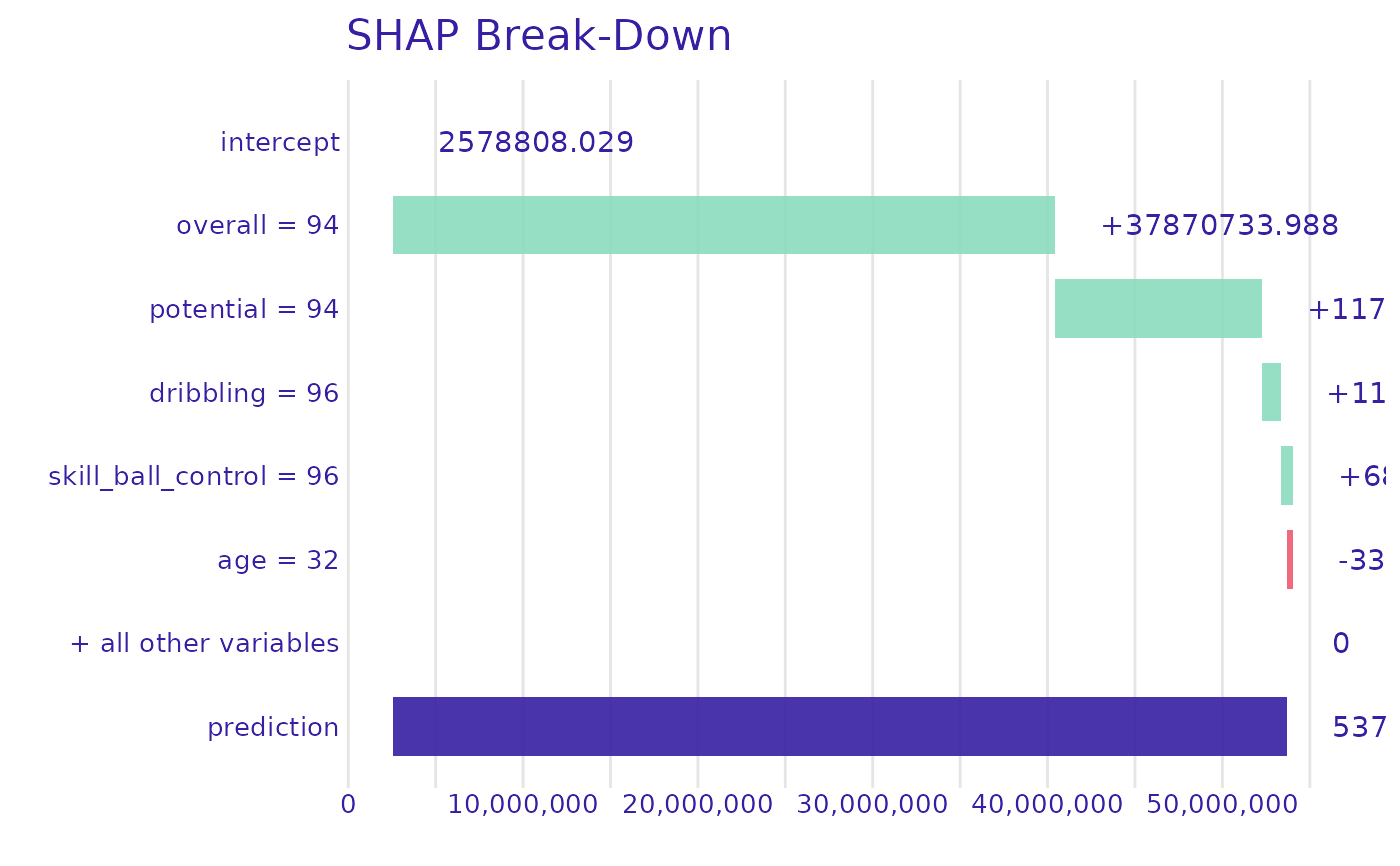
  plot_contribution(shaps, obs = 1)
}# }
#> Loading required package: R6
#>
|0%----|------|20%---|------|40%---|------|60%---|------|80%---|------|100%
#> =---------------------------------------------------------------------- (0%)

====================================----------------------------------- (50%)

======================================================================= (100%)